Showing posts with label Natural products. Show all posts

Saturday, 4 March 2023

Current trends in natural products for the treatment and management of dementia: Computational to clinical studies

 Neuroscience & Biobehavioral Reviews, 147, 105106 (2023)


The number of preclinical and clinical studies evaluating natural products-based management of dementia has gradually increased, with an exponential rise in 2020 and 2021. Keeping this in mind, we examined current trends from 2016 to 2021 in order to assess the growth potential of natural products in the treatment of dementia. Publicly available literature was collected from various databases like PubMed and Google Scholar. Oxidative stress-related targets, NF-κB pathway, anti-tau aggregation, anti-AChE, and A-β aggregation were found to be common targets and pathways. A retrospective analysis of 33 antidementia natural compounds identified 125 sustainable resources distributed among 65 families, 39 orders, and 7 classes. We found that families such as Berberidaceae, Zingiberaceae, and Fabaceae, as well as orders such as Lamiales, Sapindales, and Myrtales, appear to be important and should be researched further for antidementia compounds. Moreover, some natural products, such as quercetin, curcumin, icariside II, berberine, and resveratrol, have a wide range of applications. Clinical studies and patents support the importance of dietary supplements and natural products, which we will also discuss. Finally, we conclude with the broad scope, future challenges, and opportunities for field researchers.


Friday, 3 March 2023

Current trends in natural products for the treatment and management of dementia: Computational to clinical studies

 Neurosci. Biobehav. Rev. 147, 105106 (2023)


The number of preclinical and clinical studies evaluating natural products-based management of dementia has gradually increased, with an exponential rise in 2020 and 2021. Keeping this in mind, we examined current trends from 2016 to 2021 in order to assess the growth potential of natural products in the treatment of dementia. Publicly available literature was collected from various databases like PubMed and Google Scholar. Oxidative stress-related targets, NF-κB pathway, anti-tau aggregation, anti-AChE, and A-β aggregation were found to be common targets and pathways. A retrospective analysis of 33 antidementia natural compounds identified 125 sustainable resources distributed among 65 families, 39 orders, and 7 classes. We found that families such as Berberidaceae, Zingiberaceae, and Fabaceae, as well as orders such as Lamiales, Sapindales, and Myrtales, appear to be important and should be researched further for antidementia compounds. Moreover, some natural products, such as quercetin, curcumin, icariside II, berberine, and resveratrol, have a wide range of applications. Clinical studies and patents support the importance of dietary supplements and natural products, which we will also discuss. Finally, we conclude with the broad scope, future challenges, and opportunities for field researchers.

Sunday, 15 January 2023

The International Natural Product Sciences Taskforce (INPST) and the power of Twitter networking exemplified through #INPST hashtag analysis

 Phytomed. 108, 154520, 2023


Background
The development of digital technologies and the evolution of open innovation approaches have enabled the creation of diverse virtual organizations and enterprises coordinating their activities primarily online. The open innovation platform titled “International Natural Product Sciences Taskforce” (INPST) was established in 2018, to bring together in collaborative environment individuals and organizations interested in natural product scientific research, and to empower their interactions by using digital communication tools.

Methods
In this work, we present a general overview of INPST activities and showcase the specific use of Twitter as a powerful networking tool that was used to host a one-week “2021 INPST Twitter Networking Event” (spanning from 31st May 2021 to 6th June 2021) based on the application of the Twitter hashtag #INPST.

Results and Conclusion
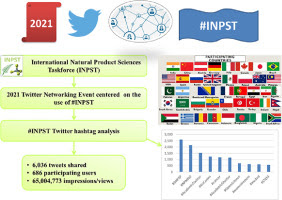
The use of this hashtag during the networking event period was analyzed with Symplur Signals (https://www.symplur.com/), revealing a total of 6,036 tweets, shared by 686 users, which generated a total of 65,004,773 impressions (views of the respective tweets). This networking event's achieved high visibility and participation rate showcases a convincing example of how this social media platform can be used as a highly effective tool to host virtual Twitter-based international biomedical research events.


Wednesday, 11 January 2023

The International Natural Product Sciences Taskforce (INPST) and the power of Twitter networking exemplified through #INPST hashtag analysis

 Phytomed. 108, 154520, 2023


Background

The development of digital technologies and the evolution of open innovation approaches have enabled the creation of diverse virtual organizations and enterprises coordinating their activities primarily online. The open innovation platform titled “International Natural Product Sciences Taskforce” (INPST) was established in 2018, to bring together in collaborative environment individuals and organizations interested in natural product scientific research, and to empower their interactions by using digital communication tools.

Methods

In this work, we present a general overview of INPST activities and showcase the specific use of Twitter as a powerful networking tool that was used to host a one-week “2021 INPST Twitter Networking Event” (spanning from 31st May 2021 to 6th June 2021) based on the application of the Twitter hashtag #INPST.

Results and Conclusion

The use of this hashtag during the networking event period was analyzed with Symplur Signals (https://www.symplur.com/), revealing a total of 6,036 tweets, shared by 686 users, which generated a total of 65,004,773 impressions (views of the respective tweets). This networking event's achieved high visibility and participation rate showcases a convincing example of how this social media platform can be used as a highly effective tool to host virtual Twitter-based international biomedical research events.