Showing posts with label apoptosis. Show all posts

Saturday, 14 January 2023

Icariin: A Promising Natural Product in Biomedicine and Tissue Engineering

 J. Funct. Biomater. 2023, 14(1), 44
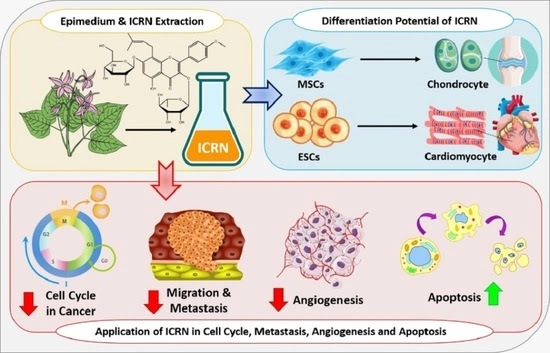

Among scaffolds used in tissue engineering, natural biomaterials such as plant-based materials show a crucial role in cellular function due to their biocompatibility and chemical indicators. Because of environmentally friendly behavior and safety, green methods are so important in designing scaffolds. A key bioactive flavonoid of the Epimedium plant, Icariin (ICRN), has a broad range of applications in improving scaffolds as a constant and non-immunogenic material, and in stimulating the cell growth, differentiation of chondrocytes as well as differentiation of embryonic stem cells towards cardiomyocytes. Moreover, fusion of ICRN into the hydrogel scaffolds or chemical crosslinking can enhance the secretion of the collagen matrix and proteoglycan in bone and cartilage tissue engineering. To scrutinize, in various types of cancer cells, ICRN plays a decisive role through increasing cytochrome c secretion, Bax/Bcl2 ratio, poly (ADP-ribose) polymerase as well as caspase stimulations. Surprisingly, ICRN can induce apoptosis, reduce viability and inhibit proliferation of cancer cells, and repress tumorigenesis as well as metastasis. Moreover, cancer cells no longer grow by halting the cell cycle at two checkpoints, G0/G1 and G2/M, through the inhibition of NF-κB by ICRN. Besides, improving nephrotoxicity occurring due to cisplatin and inhibiting multidrug resistance are the other applications of this biomaterial.


Wednesday, 2 November 2022

 Food Science and Human Wellness, 11(6), 1482-1490, 2022


The present study aimed at making a rational usage for European eel bone by-products by preparing Europen eel bone peptide chelated calcium (EBPC-Ca). Nutritional properties and bioactivity of EBPC-Ca were evaluated. Results showed that nutritional properties of calcium ions will cause intra- and inter-molecular folding and aggregation of peptide to uniformly form EBPC-Ca chelate. The chelated compound of EBPC and calcium ion triggered a strong apoptosis in heterogeneous human epithelial colorectal adenocarcinoma (Caco-2) in concentration- and time-dependent manners. Western blot analysis revealed that the EBPC-Ca induced apoptosis may be the result of a blocked autophagy flux through mitochondrial-dependent pathway. Additionally, the increase in FGF-23 protein expression inhibited the absorption of calcium ions and alleviated cell apoptosis. It was also found that the cell apoptosis occurs with significant increases in the levels of reactive oxygen species (ROS) and Ca2+ in the cells, indicating the anti-tumor potential of EBPC-Ca may involve multiple channels.


Tuesday, 26 July 2022

Advances on Natural Abietane, Labdane and Clerodane Diterpenes as Anti-Cancer Agents: Sources and Mechanisms of Action

Molecules 2022, 27(15), 4791


Extensive research over the past decades has identified numerous phytochemicals that could represent an important source of anti-cancer compounds. There is an immediate need for less toxic and more effective preventive and therapeutic strategies for the treatment of cancer. Natural compounds are considered suitable candidates for the development of new anti-cancer drugs due to their pleiotropic actions on target events with multiple manners. This comprehensive review highlighted the most relevant findings achieved in the screening of phytochemicals for anticancer drug development, particularly focused on a promising class of phytochemicals such as diterpenes with abietane, clerodane, and labdane skeleton. The chemical structure of these compounds, their main natural sources, and mechanisms of action were critically discussed.


Thursday, 3 March 2022

Morus alba L. (Sangzhi) Alkaloids Promote Insulin Secretion, Restore Diabetic β-Cell Function by Preventing Dedifferentiation and Apoptosis

 Front. Pharmacol.,  Sec. Ethnopharmacology, 2022


Background: 
Morus alba L. (Sangzhi) alkaloids (SZ-A), extracted from the Chinese herb Morus alba L. (mulberry twig), have been shown to ameliorate hyperglycemia in type 2 diabetes and have been approved for diabetes treatment in the clinic. However, their versatile pharmacologic effects and regulatory mechanisms are not yet completely understood.

Purpose: 
This study explored the protective effects of SZ-A on islet β cells and the underlying mechanism.

Methods: 
Type 2 diabetic KKAy mice were orally administered SZ-A (100 or 200 mg/kg, once daily) for 11 weeks, and oral glucose tolerance, insulin tolerance, intraperitoneal glucose tolerance and hyperglycemia clamp tests were carried out to evaluate the potency of SZ-A in vivo. The morphology and β-cell dedifferentiation marker of KKAy mouse islets were detected via immunofluorescence. The effect of SZ-A on glucose-stimulated insulin secretion was investigated in both the islet β-cell line MIN6 and mouse primary islets. Potential regulatory signals and pathways in insulin secretion were explored, and cell proliferation assays and apoptosis TUNEL staining were performed on SZ-A-treated MIN6 cells.

Results: 
SZ-A alleviated hyperglycemia and glucose intolerance in type 2 diabetic KKAy mice and improved the function and morphology of diabetic islets. In both MIN6 cells and primary islets, SZ-A promoted insulin secretion. At a normal glucose level, SZ-A decreased AMPKα phosphorylation, and at high glucose, SZ-A augmented the cytosolic calcium concentration. Additionally, SZ-A downregulated the β-cell dedifferentiation marker ALDH1A3 and upregulated β-cell identifying genes, such as Ins1, Ins2, Nkx2.2 and Pax4 in KKAy mice islets. At the same time, SZ-A attenuated glucolipotoxicity-induced apoptosis in MIN6 cells, and inhibited Erk1/2 phosphorylation and caspase 3 activity. The major active fractions of SZ-A, namely DNJ, FAG and DAB, participated in the above regulatory effects.

Conclusion:
Our findings suggest that SZ-A promotes insulin secretion in islet β cells and ameliorates β-cell dysfunction and mass reduction under diabetic conditions both in vivo and in vitro, providing additional supportive evidence for the clinical application of SZ-A.