
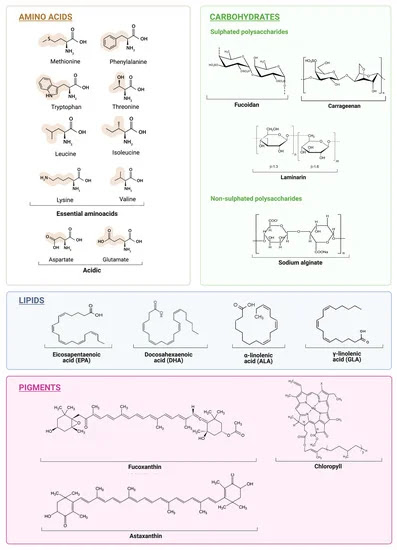
Seaweeds are an underutilized food in the Western world, but they are widely consumed in Asia, with China being the world’s larger producer. Seaweeds have gained attention in the food industry in recent years because of their composition, which includes polysaccharides, lipids, proteins, dietary fiber, and various bioactive compounds such as vitamins, essential minerals, phenolic compounds, and pigments. Extraction techniques, ranging from more traditional techniques such as maceration to novel technologies, are required to obtain these components. Pressurized liquid extraction (PLE) is a green technique that uses high temperatures and pressure applied in conjunction with a solvent to extract components from a solid matrix. To improve the efficiency of this technique, different parameters such as the solvent, temperature, pressure, extraction time and number of cycles should be carefully optimized. It is important to note that PLE conditions allow for the extraction of target analytes in a short-time period while using less solvent and maintaining a high yield. Moreover, the combination of PLE with other techniques has been already applied to extract compounds from different matrices, including seaweeds. In this way, the combination of PLE-SFE-CO2 seems to be the best option considering both the higher yields obtained and the economic feasibility of a scaling-up approximation. In addition, the food industry is interested in incorporating the compounds extracted from edible seaweeds into food packaging (including edible coating, bioplastics and bio-nanocomposites incorporated into bioplastics), food products and animal feed to improve their nutritional profile and technological properties. This review attempts to compile and analyze the current data available regarding the application of PLE in seaweeds to determine the use of this extraction technique as a method to obtain active compounds of interest for food industry application.

