Showing posts with label fungi. Show all posts

Wednesday, 22 March 2023

Fumonisin B1 Biosynthesis Is Associated with Oxidative Stress and Plays an Important Role in Fusarium proliferatum Infection on Banana Fruit

 J. Agric. Food Chem. 2023


Fungal response to oxidative stress during infection on postharvest fruit is largely unknown. Here, we found that hydrogen peroxide (H2O2) treatment inhibited the growth of Fusarium proliferatum causing crown rot of banana fruit, confirmed by scanning electron microscopy (SEM) and transmission electron microscopy (TEM) observation. H2O2 exposure increased endogenous reactive oxygen species (ROS) and fumonisin B1 (FB1) production in F. proliferatum, possibly by modulating FUM or ROS-related gene expression. Importantly, H2O2 treatment inhibited F. proliferatum growth in vivo but induced FB1 accumulation in banana peel. Finally, we constructed the FpFUM21 deletion mutant (ΔFpfum21) of F. proliferatum that was attenuated in FB1 biosynthesis and less tolerant to oxidative stress. Moreover, the ΔFpfum21 strain was less virulent compared to the wild type (WT) due to the inability to induce FB1 production in the banana host. These results suggested that FB1 biosynthesis is associated with oxidative stress in F. proliferatum and contributes to fungal infection on banana fruit.


Tuesday, 11 October 2022

Advances in Fungal Phenaloenones—Natural Metabolites with Great Promise: Biosynthesis, Bioactivities, and an In Silico Evaluation of Their Potential as Human Glucose Transporter 1 Inhibitors

Molecules 2022, 27(20), 6797


Phenaloenones are structurally unique aromatic polyketides that have been reported in both microbial and plant sources. They possess a hydroxy perinaphthenone three-fused-ring system and exhibit diverse bioactivities, such as cytotoxic, antimicrobial, antioxidant, and anti-HIV properties, and tyrosinase, α-glucosidase, lipase, AchE (acetylcholinesterase), indoleamine 2,3-dioxygenase 1, angiotensin-I-converting enzyme, and tyrosine phosphatase inhibition. Moreover, they have a rich nucleophilic nucleus that has inspired many chemists and biologists to synthesize more of these related derivatives. The current review provides an overview of the reported phenalenones with a fungal origin, including their structures, sources, biosynthesis, and bioactivities. Moreover, more than 135 metabolites have been listed, and 71 references have been cited. SuperPred, an artificial intelligence (AI) webserver, was used to predict the potential targets for selected phenalenones. Among these targets, we chose human glucose transporter 1 (hGLUT1) for an extensive in silico study, as it shows high probability and model accuracy. Among them, aspergillussanones C (60) and G (60) possessed the highest negative docking scores of −15.082 and −14.829 kcal/mol, respectively, compared to the native inhibitor of 5RE (score: −11.206 kcal/mol). The MD (molecular dynamics) simulation revealed their stability in complexes with GLUT1 at 100 ns. The virtual screening study results open up a new therapeutic approach by using some phenalenones as hGLUT1 inhibitors, which might be a potential target for cancer therapy.

Thursday, 17 February 2022

Integrated Machine Learning and Chemoinformatics-Based Screening of Mycotic Compounds against Kinesin Spindle ProteinEg5 for Lung Cancer Therapy

 Molecules 2022, 27(5), 1639
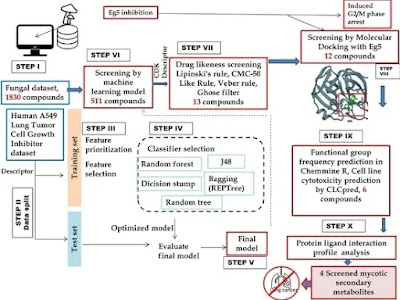


Among the various types of cancer, lung cancer is the second most-diagnosed cancer worldwide. The kinesin spindle protein, Eg5, is a vital protein behind bipolar mitotic spindle establishment and maintenance during mitosis. Eg5 has been reported to contribute to cancer cell migration and angiogenesis impairment and has no role in resting, non-dividing cells. Thus, it could be considered as a vital target against several cancers, such as renal cancer, lung cancer, urothelial carcinoma, prostate cancer, squamous cell carcinoma, etc. In recent years, fungal secondary metabolites from the Indian Himalayan Region (IHR) have been identified as an important lead source in the drug development pipeline. Therefore, the present study aims to identify potential mycotic secondary metabolites against the Eg5 protein by applying integrated machine learning, chemoinformatics based in silico-screening methods and molecular dynamic simulation targeting lung cancer. Initially, a library of 1830 mycotic secondary metabolites was screened by a predictive machine-learning model developed based on the random forest algorithm with high sensitivity (1) and an ROC area of 0.99. Further, 319 out of 1830 compounds screened with active potential by the model were evaluated for their drug-likeness properties by applying four filters simultaneously, viz., Lipinski’s rule, CMC-50 like rule, Veber rule, and Ghose filter. A total of 13 compounds passed from all the above filters were considered for molecular docking, functional group analysis, and cell line cytotoxicity prediction. Finally, four hit mycotic secondary metabolites found in fungi from the IHR were screened viz., (−)-Cochlactone-A, Phelligridin C, Sterenin E, and Cyathusal A. All compounds have efficient binding potential with Eg5, containing functional groups like aromatic rings, rings, carboxylic acid esters, and carbonyl and with cell line cytotoxicity against lung cancer cell lines, namely, MCF-7, NCI-H226, NCI-H522, A549, and NCI H187. Further, the molecular dynamics simulation study confirms the docked complex rigidity and stability by exploring root mean square deviations, root mean square fluctuations, and radius of gyration analysis from 100 ns simulation trajectories. The screened compounds could be used further to develop effective drugs against lung and other types of cancer.