Showing posts with label Cell cycle. Show all posts

Saturday, 14 January 2023

Icariin: A Promising Natural Product in Biomedicine and Tissue Engineering

 J. Funct. Biomater. 2023, 14(1), 44
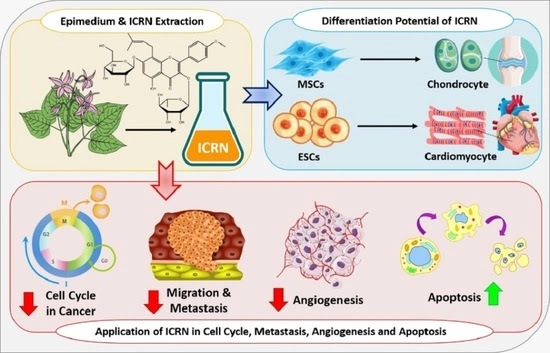

Among scaffolds used in tissue engineering, natural biomaterials such as plant-based materials show a crucial role in cellular function due to their biocompatibility and chemical indicators. Because of environmentally friendly behavior and safety, green methods are so important in designing scaffolds. A key bioactive flavonoid of the Epimedium plant, Icariin (ICRN), has a broad range of applications in improving scaffolds as a constant and non-immunogenic material, and in stimulating the cell growth, differentiation of chondrocytes as well as differentiation of embryonic stem cells towards cardiomyocytes. Moreover, fusion of ICRN into the hydrogel scaffolds or chemical crosslinking can enhance the secretion of the collagen matrix and proteoglycan in bone and cartilage tissue engineering. To scrutinize, in various types of cancer cells, ICRN plays a decisive role through increasing cytochrome c secretion, Bax/Bcl2 ratio, poly (ADP-ribose) polymerase as well as caspase stimulations. Surprisingly, ICRN can induce apoptosis, reduce viability and inhibit proliferation of cancer cells, and repress tumorigenesis as well as metastasis. Moreover, cancer cells no longer grow by halting the cell cycle at two checkpoints, G0/G1 and G2/M, through the inhibition of NF-κB by ICRN. Besides, improving nephrotoxicity occurring due to cisplatin and inhibiting multidrug resistance are the other applications of this biomaterial.


Friday, 5 June 2020

The effect of two antifungal commercial formulations on the metabolism of a commercial Saccharomyces cerevisiae strain and their repercussion on fermentation evolution and phenylalanine catabolism

 Food Microbiology, 2020, 92, 103554

DOI: 10.1016/j.fm.2020.103554


The effect of two commercial formulations (incorporating mepanipyrim and tetraconazole as active substances) on the metabolism of Saccharomyces cerevisiae Lalvin T73™, growing on a synthetic grape must, and their influence on the alcoholic fermentation course and the biosynthesis of volatiles derived from phenylalanine catabolism was studied. No relevant effects were observed for mepanipyrim except for glycerol production. On the contrary, in the presence of tetraconazole many genes and some proteins related to cell cycle progression and mitosis were repressed. This fact could explain the lower biomass concentration and the lower sugar consumption registered for tetraconazole at the end of the study. However, the biomass-to-ethanol yield was higher in connection with the overexpression of the ADH1 gene. The presence of tetraconazole residues seems to accelerate the Ehrlich pathway. These results agree with the overexpression of several genes (BAT1, PDC1, PDC5, ADH1, SFA1, ATF2, PFK1, PFK2 and ARO3) and a higher abundance of two proteins (Gap1p and Atf2p) involved in this metabolic pathway.